
Qafila Ecommece Fulfilment Log
Talk to an agent

Monthly Market Update | Ecommerce Trend – Livestream Marketing

Livestream marketing is emerging as a distinct ecommerce channel that combines live video, product demonstrations, audience interaction and a direct path to purchase. During a livestream, shoppers can see products in use, ask questions, receive recommendations and respond to limited-time offers. 

The format reduces the distance between product discovery and conversion. Instead of moving separately through advertisements, product pages, reviews and checkout, consumers can complete much of the buying journey during a single interactive session. 

The global opportunity is significant, but adoption remains uneven. Livestream commerce is mainstream in China, while the United States, Europe, Latin America and the Middle East are at earlier stages of development. Success therefore depends on adapting content, technology and commercial models to local shopping behavior. 

Global market landscape

China remains the world’s most mature livestream-commerce market. According to McKinsey: 

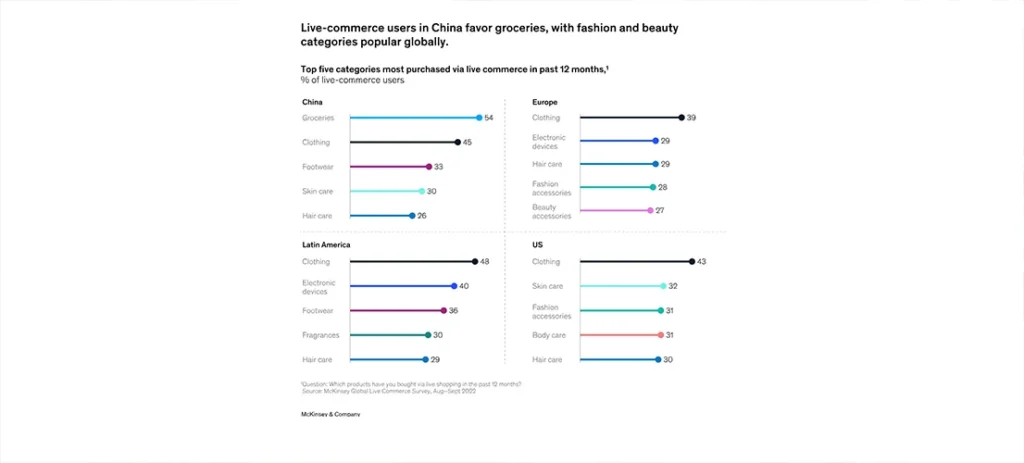
Global livestream commerce product categories showing ecommerce shopping trends across China, Europe, Latin America, and the US

1. 57% of Chinese live-commerce users had used the format for more than three years. 

2. Only 5% to 7% of users in Europe, Latin America and the United States had used it for that long. 

3. 87% of Chinese users attended live-shopping events at least monthly. 

4. Monthly participation was lower in Latin America at 64%, Europe at 52% and the United States at 43%.  

The difference reflects more than consumer awareness. China has developed highly integrated platforms where users can discover a stream, interact with the host, view products and complete payment without leaving the application. 

Outside China, the shopping journey is often fragmented. Some social platforms redirect viewers to external brand or retailer websites because embedded checkout is not universally available. This additional step can reduce conversion and make campaign measurement more difficult.  

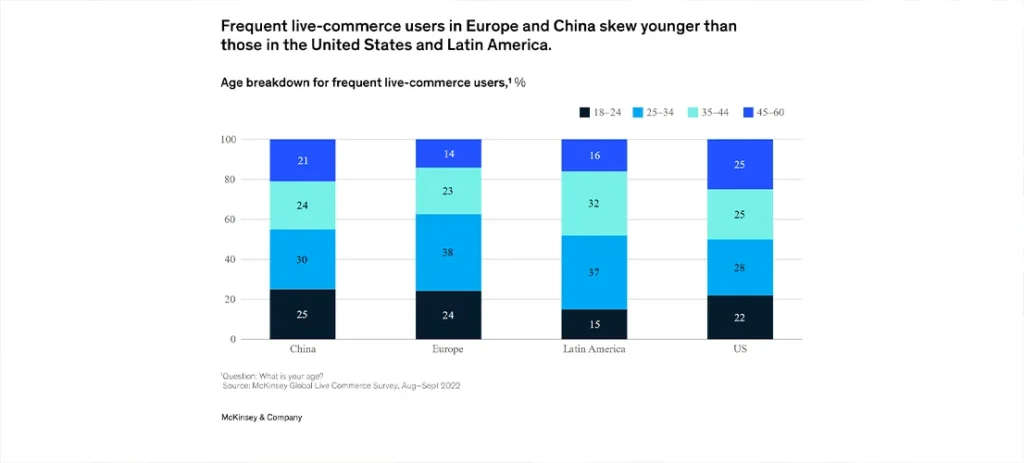
Livestream commerce user age demographics showing consumer adoption trends across global markets

Despite these limitations, the commercial case is strong. McKinsey reports that live commerce can achieve conversion rates up to 10 times higher than conventional ecommerce. Among surveyed live-commerce users, the proportion of attended shows that resulted in a purchase ranged from 30% in Europe to 36% in Latin America. These results represent engaged users rather than the general population, but they illustrate the channel’s potential. 

Factors driving growth

Several factors are supporting the expansion of livestream marketing. 

Consumer factors

1. Growing preference for video-based product discovery 

2. Demand for authentic demonstrations and recommendations 

3. Ability to ask questions before purchasing 

4. Interest in exclusive products, promotions and launches 

5. Greater trust when products are explained by credible hosts 

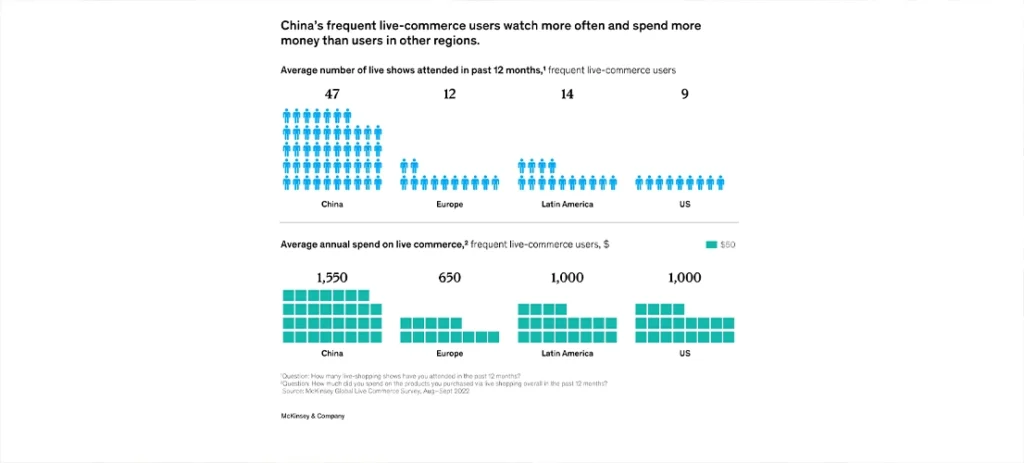
Livestream commerce user engagement and spending comparison across China, Europe, Latin America, and the US

Entertainment is especially important outside China. McKinsey found that “fun” was the leading reason frequent users participated in the United States and Europe. Better prices and deals were another major motivation. Exclusive promotions were the most popular content format across all markets surveyed. 

Technology factors

Here is a rundown of the techy aspects:

1. High smartphone penetration 

2. Faster mobile connectivity 

3. Integrated product links and payments 

4. Real-time chat and audience engagement tools 

5. Improved analytics and personalization 

6. Emerging augmented-reality shopping features 

Business factors

For brands and retailers, livestreaming can: 

1. Accelerate product discovery and conversion 

2. Reduce uncertainty around product features 

3. Support cross-selling during demonstrations 

4. Work alongside dropshipping fulfillment models to keep inventory lean

5. Generate first-party engagement data 

6. Strengthen relationships with younger audiences 

7. Differentiate the brand from conventional online retailers 

Key success factors

Livestream marketing performs best when it delivers useful content rather than functioning as a continuous sales pitch. 

Successful broadcasts usually include: 

  • A knowledgeable and credible presenter 
  • Clear product demonstrations 
  • Real-time questions and answers 
  • Stream-exclusive discounts or products 
  • A simple purchasing journey 
  • Convenient scheduling 
  • A focused broadcast length 
  • Strong promotion before the event


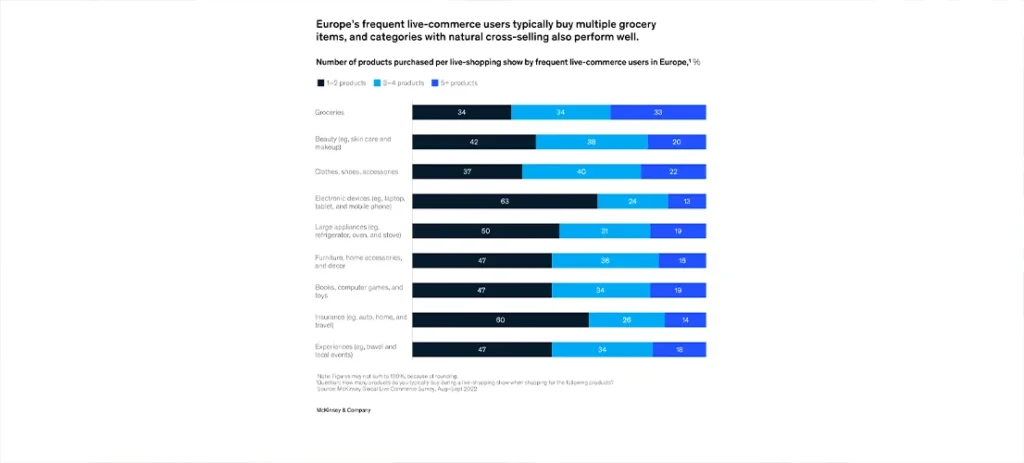
The product category also matters. Clothing is the most popular livestream-shopping category in the United States, Europe and Latin America. Fashion, beauty, electronics and health products are well suited to the format because they benefit from visual explanation, comparison and demonstration. 

Europe livestream commerce product purchase trends showing popular categories and cross-selling opportunities

Barriers to adoption

Livestream marketing is not automatically successful. McKinsey identified several recurring barriers: 

  • Inconvenient broadcast times 
  • Shows that are too long 
  • Repetitive product demonstrations 
  • Content that feels overly promotional 
  • Limited product or brand availability 
  • Concerns about value for money 
  • Difficulty choosing between products


Brands must also manage production costs, presenter selection, inventory availability, order fulfillment and customer service, including returns management in ecommerce when livestream purchases are exchanged or returned. A strong livestream can create rapid demand, but poor stock visibility, weak reverse logistics for e-commerce, or slow delivery can damage trust.

Middle East outlook

The Middle East remains an emerging live-commerce market, supported by ecommerce growth, mobile connectivity and widespread social-media use. 

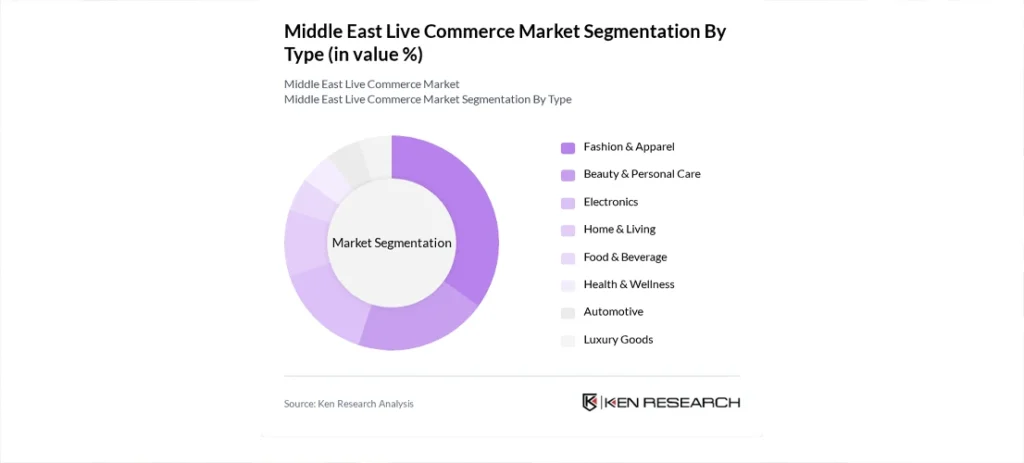
Ken Research estimates the regional market at approximately USD 825 million, with the UAE, Saudi Arabia and Egypt identified as leading markets. Fashion and apparel is described as the largest category, while health and wellness is positioned as an emerging segment.  

Key regional growth factors include: 

  • Young, digitally active populations 
  • Strong smartphone and internet usage 
  • Expanding ecommerce platforms 
  • Large influencer and creator communities 
  • Consumer interest in interactive shopping 
  • Investment in digital retail infrastructure


However, regional adoption faces challenges. These include different regulatory requirements across countries, including varying ecommerce customs clearance procedures, limited awareness of livestream shopping and the need to build confidence around product authenticity, payments, returns and customer support.

The USD 825 million figure should be treated as a commercial research estimate. Research and Markets distributes the same Ken Research report, meaning the two sources do not represent separate market estimates.

UAE market perspective

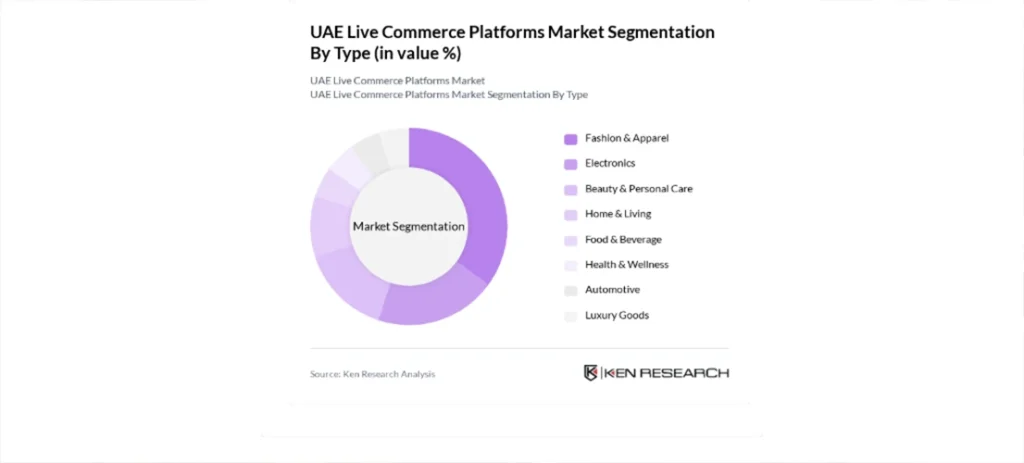
The UAE has particularly strong foundations for livestream marketing. Ken Research estimates the UAE live-commerce platforms market at approximately USD 195 million, with Dubai and Abu Dhabi positioned as the main centres of activity.  

The main UAE growth factors are: 

  • High smartphone and high-speed internet penetration 
  • Rapid 5G adoption 
  • Strong ecommerce and retail ecosystems 
  • Cosmopolitan and multilingual audiences 
  • Established influencer marketing activity 
  • High consumer interest in premium and digital experiences 
  • Advanced logistics and payment infrastructure


Fashion and apparel is identified as the leading UAE segment, reflecting strong demand for apparel ecommerce shipping and fashion ecommerce shipping solutions that keep pace with livestream-driven order volumes, while health and wellness is expected to grow as consumers seek product education and interactive demonstrations.

The UAE nevertheless remains a developing market. Consumer trust, regulatory compliance, data protection, product authenticity and technology costs for smaller businesses may restrict adoption. 

Strategic outlook

Livestream marketing is unlikely to replace traditional ecommerce. Instead, it will become a high-engagement layer within selected customer journeys, particularly for product launches, demonstrations, seasonal campaigns and creator partnerships. 

For UAE and Middle Eastern retailers, the priority should be controlled experimentation. Brands should begin with demonstration-friendly categories, trusted local hosts, bilingual or multilingual content and exclusive offers. Performance should be measured through watch time, engagement, product clicks, add-to-cart rates, conversion, average order value and post-event sales. 

The market opportunity is credible, but long-term success will depend less on broadcasting frequently and more on producing relevant, localized and commercially integrated experiences. 

You May Also Like

Monthly Market Update | Ecommerce Trend – Livestream Marketing

Monthly Market Update | Ecommerce Trend – Livestream Marketing

Monthly Market Update | Ecommerce Trend – Livestream Marketing Livestream marketing is emerging as a distinct ecommerce channel that combines live video, product demonstrations, audience interaction and a direct path to purchase. During a livestream, shoppers can see products in use, ask questions, receive recommendations and respond to limited-time offers.  The format reduces the distance between product discovery and conversion. Instead of moving […]

Monthly Market Update: The State and Evolution of Quick Commerce & 30–60 Minute Delivery in UAE & MENA

Monthly Market Update: The State and Evolution of Quick Commerce & 30–60 Minute Delivery in UAE & MENA

Monthly Market Update: The State and Evolution of Quick Commerce & 30–60 Minute Delivery in UAE & MENA Quick commerce is becoming one of the fastest-shaping segments of retail in the UAE and wider MENA region. What started as grocery delivery within a few hours has evolved into a highly competitive “instant delivery” ecosystem where 10 […]

Middle East Online Marketplaces Market Update- June 2026

Middle East Online Marketplaces Market Update- June 2026

Scaling Peak-Season Fulfillment for a Consumer Electronics Retailer The ecommerce market across the Middle East is growing strongly in so far in 2026, supported by rising internet access, smartphone adoption, faster logistics, and expanding digital payments systems. Overall sales continue to rise year over year, driven by consumers buying more online across categories like electronics, fashion, beauty, and […]

Market Update: Ecommerce Packaging Becomes a Growth, Fulfilment and Compliance Priority 

Market Update: Ecommerce Packaging Becomes a Growth, Fulfilment and Compliance Priority 

From Warehouse to Living Room: Qafila’s White-Glove Packaging and Delivery For Consumer Electronics Brand Ecommerce packaging is no longer just a box, pouch or protective wrap. It has become a key part of how retailers manage cost, protect products, meet sustainability expectations, improve fulfilment efficiency, and influence customer loyalty.  As ecommerce continues to grow globally, packaging is being pushed […]

Ecommerce Growth Drivers in 2026- Global and UAE Market Update 

Ecommerce Growth Drivers in 2026- Global and UAE Market Update 

Enhancing Last-Mile Delivery for a Smart Home Tech Retailer Introduction Ecommerce continues to reshape how people shop, offering faster, more personal, and more convenient experiences than ever before. In 2026, both global consumer demand and business innovation are powering higher online sales across categories, from fashion to electronics. Technology, changing consumer habits, and smarter logistics remain key forces […]

ECommerce Packaging Trends and Insights 2026: Monthly Market Update

ECommerce Packaging Trends and Insights 2026: Monthly Market Update

Zero Backlogs, Faster Deliveries: Qafila’s Peak-Season Fulfillment Success Story for an Electronics Brand Introduction In 2026, eCommerce packaging is being pulled in three directions at once: cost pressure from shipping and returns, rising sustainability expectations, and the need to stand out in a crowded digital shelf. Across markets, the “winning” packaging playbook looks less like […]