Qafila Ecommece Fulfilment Log
Talk to an agent

Holiday Shopping 2026: Consumer Spending, Digital Shopping and Delivery Trends

The 2026 holiday shopping season is taking shape amid changing consumer spending habits, growing digital adoption, and higher expectations for fulfilment and delivery. Across global markets, shoppers are becoming more selective about purchases while increasingly using promotions, digital platforms, and artificial intelligence (AI) to guide decisions. 

In the Middle East and North Africa (MENA), particularly the UAE and Saudi Arabia, the shopping season is expanding beyond White Friday into a longer promotional period.

For retailers, this creates opportunities to reach customers earlier while placing greater pressure on inventory management, warehousing, and ecommerce logistics.

Global Holiday Spending Remains Resilient Despite Budget Pressures

Holiday retail spending is expected to grow in 2026, although consumers remain cautious about rising prices. The National Retail Federation (NRF) forecasts US holiday retail sales will increase 4.2% year over year to $1.013 trillion during November and December 2026. 

Meanwhile, Deloitte’s 2026 Holiday Retail Survey projects average US household spending of $1,654, up 4% from 2025. Spending on retail goods is expected to rise 10% to $988, while spending on holiday activities declines 4% to $666. 

However, affordability remains a major influence. NRF reports that 56% of holiday shoppers expect economic conditions to affect spending plans, with many seeking discounts and comparing prices. 

Deloitte also identifies 38% of respondents as value seekers who actively adopt money-saving strategies. Interestingly, these consumers expect to spend 12% more than other shoppers, indicating that deal-seeking does not necessarily mean lower purchasing activity. 

Younger Generations Are Driving Holiday Shopping Demand

Demographic trends are playing a significant role in shaping seasonal demand. According to Deloitte’s 2026 Holiday Retail Survey, Generation Z and millennials are expected to account for 50% of US holiday spending, reflecting their growing purchasing influence. 

Among Gen Z consumers, 76% plan to purchase clothing and accessories as gifts, while 49% intend to buy something for themselves. Across all surveyed shoppers, 33% plan to purchase self-gifts. 

Income also influences spending. US households earning over $200,000 annually expect to spend an average of $3,607, compared with $693 among households earning below $50,000. 

These differences highlight the importance of catering to multiple consumer segments, from budget-conscious shoppers seeking promotions to higher-income buyers purchasing premium products. 

What Are Consumers Buying During the Holidays?

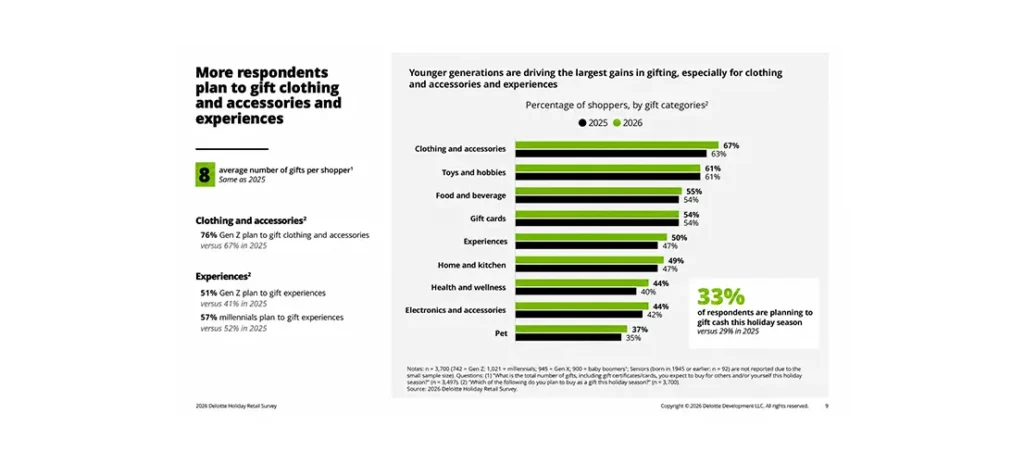
Deloitte 2026 Holiday Retail Survey comparing popular holiday gift categories, including clothing, accessories, toys, and experiences

Traditional holiday gifts remain popular, but purchasing preferences are evolving. Deloitte reports that clothing and accessories lead planned US gift purchases at 67%, followed by toys and hobbies at 61%, food and beverages at 55%, and gift cards at 54%. Electronics, home products, and wellness items also feature prominently. 

Experience-based gifting is gaining popularity, with 50% of respondents planning to gift an experience, compared with 39% in 2024. 

Meanwhile, Adobe’s 2026 Holiday Shopping Forecast suggests shoppers are increasingly using seasonal promotions to purchase everyday essentials, including clothing basics, personal hygiene products, and household cleaning supplies. 

For retailers, this wider product mix creates different operational requirements. Fashion ecommerce shipping demands accurate inventory planning and dependable dispatch, while gift set kitting can help businesses product bundles for promotional changes. 

As demand spreads across fashion, consumer electronics, FMCG, and seasonal merchandise, retailers need flexible fulfilment operations that can handle changing order volumes and product requirements.

Shopping Channels Are Becoming More Connected

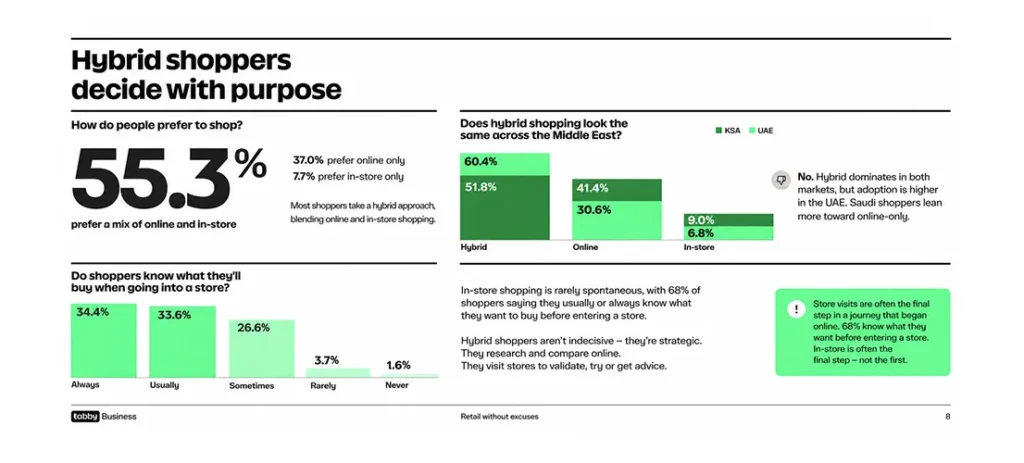
Tabby Business research showing 55.3% of shoppers prefer a combination of online and in-store shopping across the Middle East.

Consumers increasingly combine online product discovery with physical shopping experiences. 

Deloitte estimates 55% of US retail holiday budgets will be spent online, compared with 45% in physical stores. However, NRF reports that only 53% of US holiday shoppers plan to shop online, the lowest proportion since 2015. 

The growth of AI is also transforming how consumers research products. Accenture’s 2026 Holiday Shopping Survey, covering more than 16,000 respondents across 10 countries, finds that four in ten shoppers expect to use generative AI during holiday shopping. 

Adobe also forecasts AI-driven traffic to US retail websites will increase 130% year over year during the holiday period. 

Together, these developments suggest retailers need to deliver consistent product information, pricing, and availability across websites, marketplaces, social platforms, and physical stores. 

MENA's Holiday Shopping Season Is Becoming a 90-Day Event

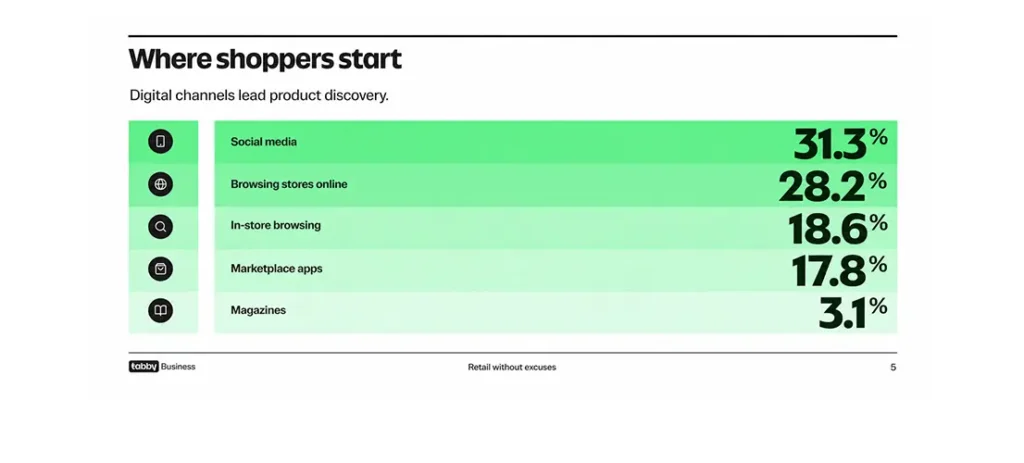
Middle East ecommerce survey showing social media, online stores, and marketplace apps as popular product discovery channels.

In MENA, seasonal retail activity is no longer concentrated around a single promotional weekend. 

According to Think with Google’s September 2026 analysis, shopping momentum begins around Saudi National Day in September, continues through October promotions, accelerates during November’s White Friday events, and extends into UAE National Day and year-end sales. 

During White Friday week in 2025, regional search interest for retailers and brands increased 15% week over week, including 10% in the UAE and 20% in Saudi Arabia. Shopping app downloads across the UAE and Saudi Arabia also rose 43% in November compared with October. 

For retailers, longer promotional periods mean inventory and delivery planning must begin well before peak sales events. Businesses managing ecommerce fulfillment in Dubai and other regional distribution hubs may need to prepare additional storage capacity, coordinate inventory replenishment, and scale order processing throughout the season. Rather than preparing for one major sales weekend, retailers increasingly need fulfilment operations capable of supporting several months of fluctuating demand.

UAE and Saudi Shoppers Prioritize Convenience and Flexibility

The Tabby Ultimate Middle East Shopping Survey 2026, involving 20,999 respondents across the UAE and Saudi Arabia, highlights changing shopping habits. 

The survey finds that 77.2% of product discovery takes place through digital channels, while 55.3% of shoppers prefer combining online and physical shopping. Social media accounts for 31.3% of product discovery, followed by online store browsing at 28.2% and marketplace apps at 17.8%. 

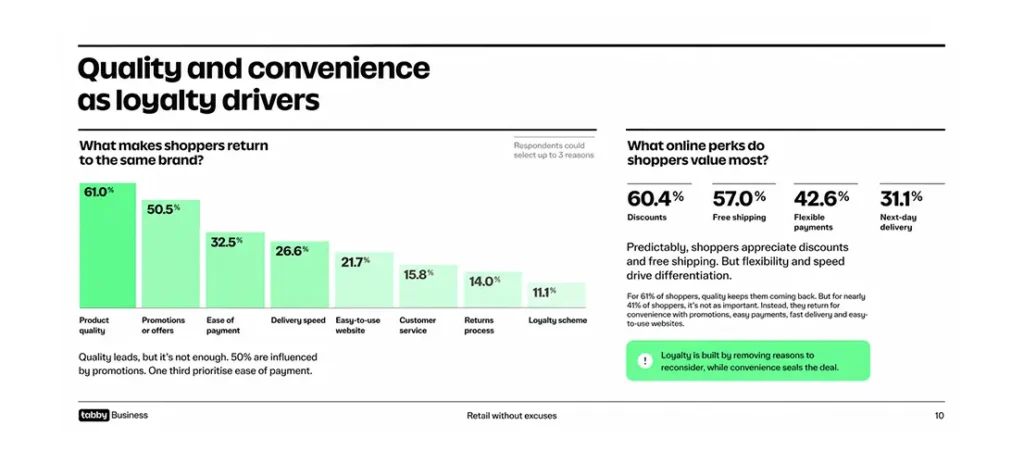
Payment flexibility is another major consideration, with 69.9% saying they would avoid retailers that do not offer flexible payment options. Delivery also influences regional purchasing decisions. Among surveyed shoppers, 57% value free shipping, while 31.1% prioritize next-day delivery. 

These findings demonstrate how digital accessibility, convenient checkout, and dependable delivery increasingly influence retail competitiveness.

Fulfilment and Delivery Are Becoming Critical to Holiday Sales

Delivery expectations are emerging as a decisive factor in converting holiday shopping demand into completed purchases. 

According to DHL’s 2026 Black Friday Trend Report, covering shoppers across 29 countries, 81% would abandon purchases without preferred delivery options, while 74% would abandon purchases without suitable returns options. Additionally, 77% would avoid retailers if they did not trust their delivery or returns provider. 

DHL’s broader 2026 E-Commerce Trends Report finds that 70% of surveyed online shoppers purchase internationally, highlighting the growing importance of cross-border logistics. 

Returns are another important consideration. Effective reverse logistics for e-commerce helps retailers manage returned products, process them efficiently, and return suitable inventory to available stock. For businesses preparing for seasonal demand, the priority is not simply increasing shipping capacity. It is ensuring orders move smoothly from inventory storage and picking through packing, dispatch, delivery, and returns.

In the UAE and Saudi Arabia, Tabby’s research identifies high shipping costs, slow delivery, and hidden fees among the reasons customers abandon online purchases. For retailers, these findings underline the importance of inventory visibility, efficient order fulfilment, transparent shipping charges, accurate delivery timelines, and streamlined returns processing.

What the 2026 Holiday Season Means for Supply Chains?

Holiday shopping is evolving into a longer, more digitally connected retail season, where consumers expect competitive prices without compromising convenience. 

For retailers and logistics providers, the challenge extends beyond managing seasonal sales volumes. Businesses must anticipate demand earlier, coordinate inventory across sales channels, increase fulfilment capacity during promotional peaks, and provide reliable delivery experiences. Reliable ecommerce fulfillment services can support these requirements by connecting warehousing, inventory  management, order processing, distribution and return handling

As the UAE and wider MENA retail markets continue embracing digital commerce, integrated warehousing, distribution, cross-border fulfillment and shipping operations, and last mile delivery capabilities will play an increasingly important role in supporting seasonal retail growth.

You May Also Like

Holiday Shopping 2026: Consumer Spending, Digital Shopping and Delivery Trends

Holiday Shopping 2026: Consumer Spending, Digital Shopping and Delivery Trends

Holiday Shopping 2026: Consumer Spending, Digital Shopping and Delivery Trends The 2026 holiday shopping season is taking shape amid changing consumer spending habits, growing digital adoption, and higher expectations for fulfilment and delivery. Across global markets, shoppers are becoming more selective about purchases while increasingly using promotions, digital platforms, and artificial intelligence (AI) to guide […]

Monthly Market Update – Delivery Speed and Fulfilment Become Competitive Differentiators

Monthly Market Update – Delivery Speed and Fulfilment Become Competitive Differentiators

Monthly Market Update – Delivery Speed and Fulfilment Become Competitive Differentiators E-commerce competition is increasingly moving beyond price, product assortment and digital experience. Delivery speed, fulfilment reliability and inventory proximity are becoming central parts of the customer proposition.  Global consumer expectations continue to rise. DHL’s 2026 global e-commerce research, covering 29,000 shoppers and 5,800 businesses […]

Monthly Market Update – AI Is Reshaping Global Commerce and Creating New Opportunities in the Middle East

Monthly Market Update – AI Is Reshaping Global Commerce and Creating New Opportunities in the Middle East

Monthly Market Update – AI Is Reshaping Global Commerce and Creating New Opportunities in the Middle East The ecommerce industry has always been shaped by changes in how consumers discover products. First, search engines became the gateway to online shopping. Then marketplaces such as Amazon transformed product discovery by bringing search, reviews and purchasing into one platform. More recently, […]

Monthly Market Update | Ecommerce Trend – Livestream Marketing

Monthly Market Update | Ecommerce Trend – Livestream Marketing

Monthly Market Update | Ecommerce Trend – Livestream Marketing Livestream marketing is emerging as a distinct ecommerce channel that combines live video, product demonstrations, audience interaction and a direct path to purchase. During a livestream, shoppers can see products in use, ask questions, receive recommendations and respond to limited-time offers.  The format reduces the distance between product discovery and conversion. Instead of moving […]

Monthly Market Update: The State and Evolution of Quick Commerce & 30–60 Minute Delivery in UAE & MENA

Monthly Market Update: The State and Evolution of Quick Commerce & 30–60 Minute Delivery in UAE & MENA

Monthly Market Update: The State and Evolution of Quick Commerce & 30–60 Minute Delivery in UAE & MENA Quick commerce is becoming one of the fastest-shaping segments of retail in the UAE and wider MENA region. What started as grocery delivery within a few hours has evolved into a highly competitive “instant delivery” ecosystem where 10 […]

Middle East Online Marketplaces Market Update- June 2026

Middle East Online Marketplaces Market Update- June 2026

Scaling Peak-Season Fulfillment for a Consumer Electronics Retailer The ecommerce market across the Middle East is growing strongly in so far in 2026, supported by rising internet access, smartphone adoption, faster logistics, and expanding digital payments systems. Overall sales continue to rise year over year, driven by consumers buying more online across categories like electronics, fashion, beauty, and […]