
Qafila Ecommece Fulfilment Log
Talk to an agent

Monthly Market Update – AI Is Reshaping Global Commerce and Creating New Opportunities in the Middle East

The ecommerce industry has always been shaped by changes in how consumers discover products. First, search engines became the gateway to online shopping. Then marketplaces such as Amazon transformed product discovery by bringing search, reviews and purchasing into one platform. More recently, social commerce platforms like TikTok changed the journey by turning content and recommendations into buying opportunities. 

The next transformation is now emerging: artificial intelligence is becoming a new layer between consumers and brands.

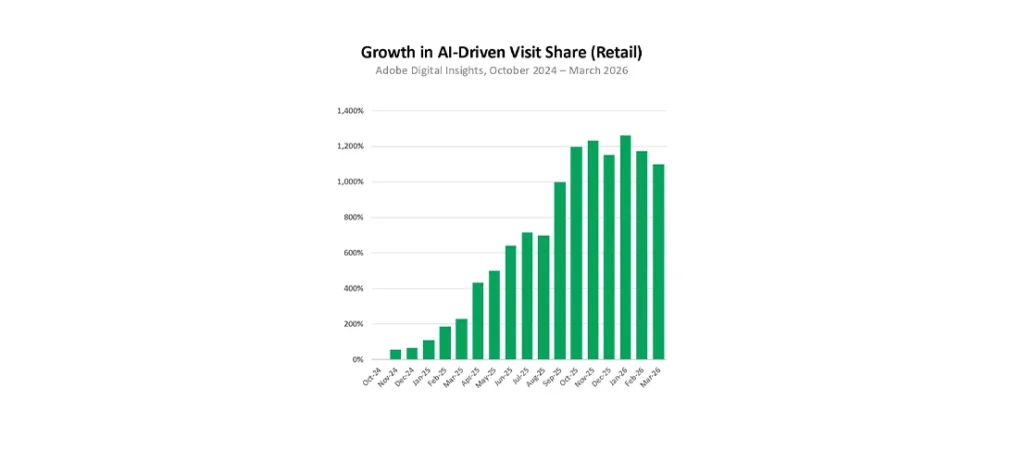
Chart showing strong growth in AI-driven visits to retail ecommerce websites from 2024 to 2026.

Instead of searching through thousands of products, comparing multiple websites and reading endless reviews, shoppers are increasingly using AI assistants to understand their needs, evaluate options and receive personalised recommendations. 

This shift does not mean AI will immediately replace ecommerce websites or marketplaces. Instead, it represents a change in where purchasing decisions begin. The future competition may not only be about ranking higher on Google or marketplaces, but about becoming the product that AI recommends.

Global Market: The Rise of AI-Powered Product Discovery

AI is moving ecommerce from keyword-based search toward intent-based discovery. Traditional ecommerce depends on consumers knowing what they want and searching for it. A shopper looking for a laptop might search “best business laptop 2026” and manually compare results. 

AI changes this interaction. Consumers can now describe their situation and expectations: 

“I travel frequently, need a lightweight laptop for work, and have a budget of $1,500. What should I buy?” 

The AI assistant can analyse preferences, compare products and provide recommendations based on the consumer’s specific needs. This makes AI increasingly valuable at the earliest stage of the customer journey: discovery. 
 

Adobe Digital Insights highlighted the commercial impact of this shift. Its 2026 analysis found that AI-referred traffic to retail websites increased significantly, while visitors arriving from AI platforms demonstrated stronger purchasing behaviour.  

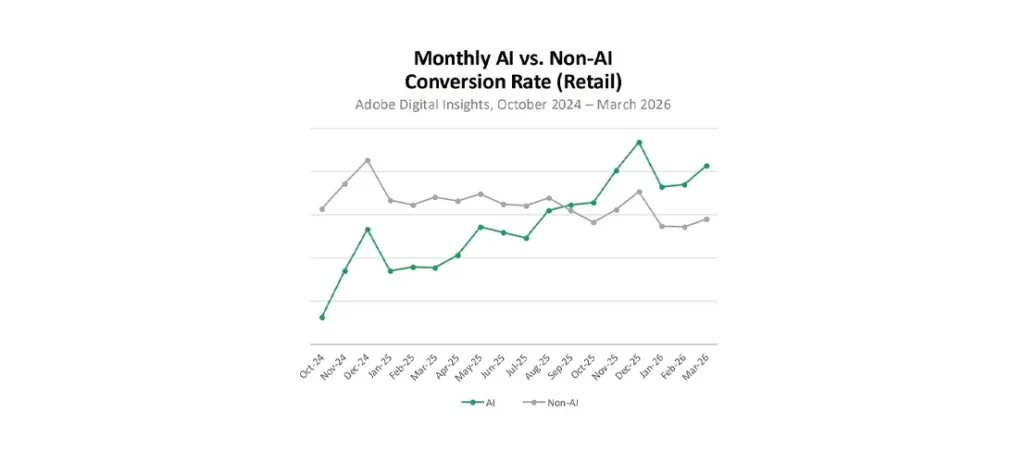
Chart comparing AI-referred and non-AI retail conversion rates, with AI traffic showing stronger conversion performance.

AI-referred shoppers generated higher engagement and stronger conversion performance compared with traditional traffic sources, showing that AI is not only influencing awareness but also purchase intent. 

For ecommerce businesses, this creates a new challenge. Visibility will no longer depend only on search rankings, advertising budgets or marketplace placement. Brands will also need to ensure their products are accurately understood by AI systems.

Detailed product descriptions, specifications, pricing, availability, reviews and structured information could all become increasingly important as AI product discovery becomes part of the normal shopping journey.

Technology Companies Are Building the Future of AI Commerce

The largest technology and ecommerce companies are already investing heavily in this transition. 

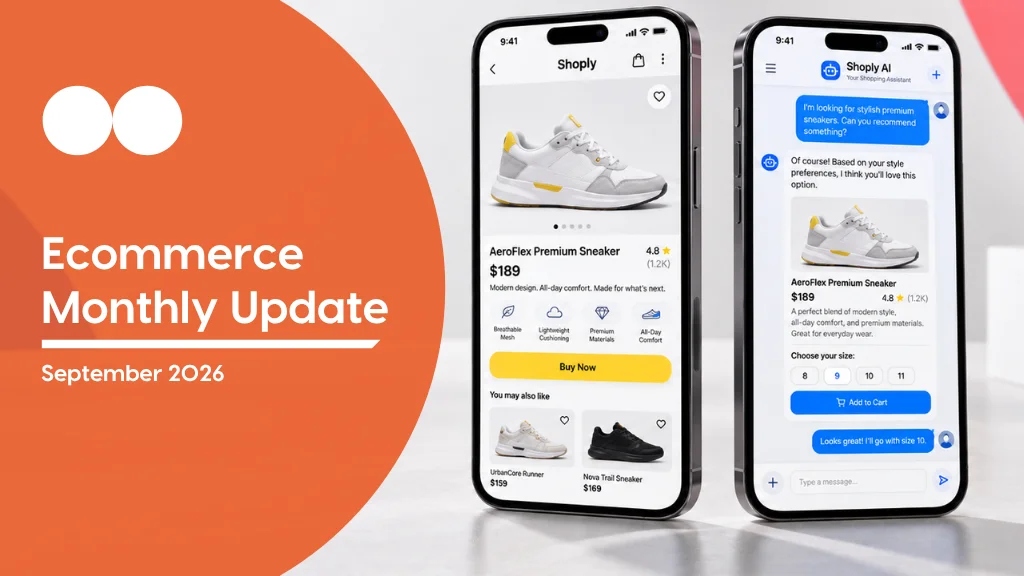
AI shopping assistant recommending skincare products through a mobile ecommerce experience.

Shopify is developing infrastructure that allows merchants to participate in AI-powered shopping experiences. The company has reported strong growth in AI-driven traffic and orders, showing that AI referrals are becoming a measurable sales channel for online businesses. 

Amazon is also expanding conversational shopping through AI assistants that help customers discover products, compare alternatives and make more informed decisions. Rather than replacing its marketplace, Amazon is adding an intelligence layer that improves the shopping experience. 

Google, OpenAI, Microsoft and Meta are following similar paths by connecting AI assistants with product information, merchants and payment systems. 

This competition highlights an important shift. The future of ecommerce may not only be about owning the marketplace where transactions happen. It may be about controlling the intelligent interface that guides consumers toward those transactions and, just as importantly, the fulfillment and reverse logistics ecommerce networks that make those transactions deliverable and returnable at scale.

AI Shopping Adoption Is Growing, But Trust Remains Critical

While AI-powered shopping is expanding, consumers are still cautious about giving AI complete control over purchasing decisions.

Current adoption is strongest in areas where AI acts as an assistant:

  • Finding products
  • Comparing options
  • Summarising reviews
  • Discovering new brands
  • Providing recommendations

However, consumers remain more hesitant when AI is expected to make final decisions involving payments, personal preferences or brand selection.

This creates an important distinction for the market.

The immediate future of ecommerce is not fully autonomous shopping. It is AI-assisted commerce. The biggest impact of AI will likely come from helping consumers decide what products deserve their attention.

This creates a new competitive factor for brands: AI visibility.

Businesses will need stronger product information, accurate inventory data, detailed specifications and trusted customer reviews to ensure AI systems can understand and recommend their products. Behind that visibility sits the operational reality of ecommerce fulfillment and reverse logistics in e-commerce because a product AI recommends still has to be picked, packed, shipped and, when necessary, returned smoothly.

Middle East and UAE: A Market Positioned for AI Commerce Growth

While AI commerce is developing globally, the Middle East, particularly the UAE, has several advantages that could accelerate adoption. The region combines strong digital infrastructure, widespread smartphone usage, growing ecommerce activity and rapidly developing digital payment ecosystems. Together, these factors provide a strong foundation for the expansion of AI ecommerce Middle East experiences.

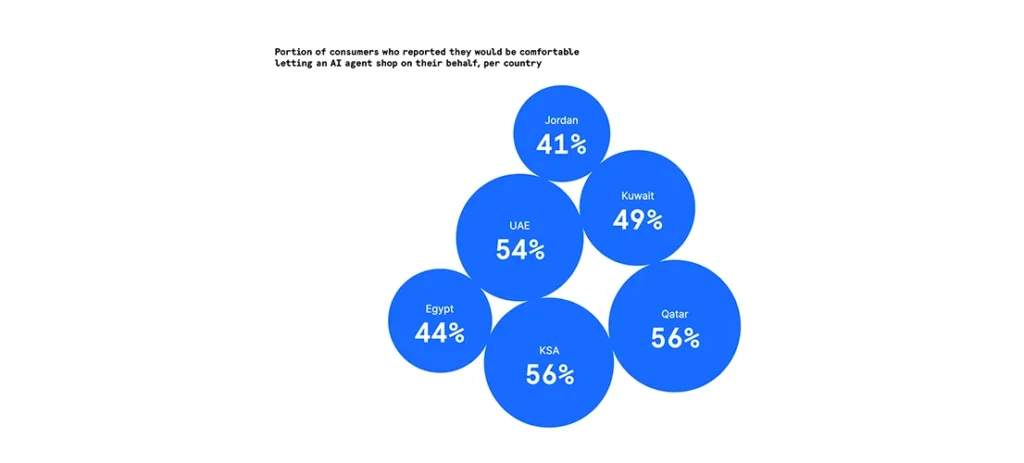
Research from Checkout.com’s MENA Digital Commerce Report shows strong consumer interest in AI-powered shopping experiences. Many consumers across the region are becoming familiar with AI assistants and see value in using technology to simplify product discovery and purchasing decisions. 

This creates significant potential for AI shopping UAE adoption, particularly as digital commerce platforms, retailers and payment providers continue introducing new AI capabilities.

Consumer comfort with AI agent shopping across the UAE, Saudi Arabia, Qatar, Kuwait, Egypt and Jordan.

The UAE stands out because the market is already moving beyond consumer adoption into infrastructure development.  That includes the physical backbone of online retail, ecommerce fulfillment in Dubai and across the GCC, along with the cross-border delivery networks that connect the region to global buyers.

Payment companies are testing how AI agents can participate in commerce securely. Mastercard, together with Majid Al Futtaim, has explored agentic payment experiences in the UAE, demonstrating how AI systems could eventually connect product discovery with transactions. 

Visa has also been exploring AI-powered payment solutions in the region, highlighting the importance of secure payment infrastructure for the future of agentic commerce. These initiatives are helping establish the country as an important testing ground for agentic commerce UAE development.

These developments position the UAE as an important testing ground for the next generation of ecommerce.

From AI Discovery to Ecommerce Fulfillment

AI may change how a customer discovers a product, but the physical requirements of ecommerce remain unchanged.

Once an AI recommendation becomes an order, the retailer still needs to manage inventory, process the purchase, pick and pack the product, arrange delivery and handle potential returns.

This means the growth of AI-assisted commerce could also increase pressure on ecommerce fulfillment services. Faster product discovery can create higher expectations around product availability, delivery speed and visibility after checkout.

For UAE businesses serving customers across different markets, cross-border fulfillment may become particularly important. AI platforms can make international products easier to discover, potentially exposing regional brands to customers who previously would not have found them through traditional search channels.

That opportunity also creates an operational challenge. A brand recommended to customers in several countries must be capable of reliably fulfilling those orders.

As AI reduces friction during product discovery, ecommerce companies will need to make sure that their logistics operations do not become the next source of friction.

What This Means for Ecommerce Businesses ?

For global and regional ecommerce companies, AI represents both an opportunity and a challenge. Businesses will need to move beyond traditional digital marketing strategies and prepare for an environment where AI influences consumer decisions. 

Product data will become increasingly important. Clear descriptions, accurate pricing, availability information and customer reviews will determine how effectively AI systems understand and recommend products. 

Brands will also need to focus on trust. AI recommendations will depend heavily on credibility, customer satisfaction and reliable information including the confidence that orders will be fulfilled and returns handled well. This is where strong ecommerce fulfillment and cross-border ecommerce capabilities, along with sustainable fulfillment practices that a growing share of shoppers now expect, become a genuine competitive advantage.

The ecommerce leaders of the future will not only be companies with the largest advertising budgets or product catalogues. They will be companies that successfully adapt their products, data and operations for an AI-driven shopping environment. 

Artificial intelligence is not replacing ecommerce. It is becoming the new layer through which ecommerce decisions are made. 

The next generation of online shopping will belong to businesses that are not only visible to consumers, but also visible and trusted by AI. 

You May Also Like

Monthly Market Update – AI Is Reshaping Global Commerce and Creating New Opportunities in the Middle East

Monthly Market Update – AI Is Reshaping Global Commerce and Creating New Opportunities in the Middle East

Monthly Market Update – AI Is Reshaping Global Commerce and Creating New Opportunities in the Middle East The ecommerce industry has always been shaped by changes in how consumers discover products. First, search engines became the gateway to online shopping. Then marketplaces such as Amazon transformed product discovery by bringing search, reviews and purchasing into one platform. More recently, […]

Monthly Market Update | Ecommerce Trend – Livestream Marketing

Monthly Market Update | Ecommerce Trend – Livestream Marketing

Monthly Market Update | Ecommerce Trend – Livestream Marketing Livestream marketing is emerging as a distinct ecommerce channel that combines live video, product demonstrations, audience interaction and a direct path to purchase. During a livestream, shoppers can see products in use, ask questions, receive recommendations and respond to limited-time offers.  The format reduces the distance between product discovery and conversion. Instead of moving […]

Monthly Market Update: The State and Evolution of Quick Commerce & 30–60 Minute Delivery in UAE & MENA

Monthly Market Update: The State and Evolution of Quick Commerce & 30–60 Minute Delivery in UAE & MENA

Monthly Market Update: The State and Evolution of Quick Commerce & 30–60 Minute Delivery in UAE & MENA Quick commerce is becoming one of the fastest-shaping segments of retail in the UAE and wider MENA region. What started as grocery delivery within a few hours has evolved into a highly competitive “instant delivery” ecosystem where 10 […]

Middle East Online Marketplaces Market Update- June 2026

Middle East Online Marketplaces Market Update- June 2026

Scaling Peak-Season Fulfillment for a Consumer Electronics Retailer The ecommerce market across the Middle East is growing strongly in so far in 2026, supported by rising internet access, smartphone adoption, faster logistics, and expanding digital payments systems. Overall sales continue to rise year over year, driven by consumers buying more online across categories like electronics, fashion, beauty, and […]

Market Update: Ecommerce Packaging Becomes a Growth, Fulfilment and Compliance Priority 

Market Update: Ecommerce Packaging Becomes a Growth, Fulfilment and Compliance Priority 

From Warehouse to Living Room: Qafila’s White-Glove Packaging and Delivery For Consumer Electronics Brand Ecommerce packaging is no longer just a box, pouch or protective wrap. It has become a key part of how retailers manage cost, protect products, meet sustainability expectations, improve fulfilment efficiency, and influence customer loyalty.  As ecommerce continues to grow globally, packaging is being pushed […]

Ecommerce Growth Drivers in 2026- Global and UAE Market Update 

Ecommerce Growth Drivers in 2026- Global and UAE Market Update 

Enhancing Last-Mile Delivery for a Smart Home Tech Retailer Introduction Ecommerce continues to reshape how people shop, offering faster, more personal, and more convenient experiences than ever before. In 2026, both global consumer demand and business innovation are powering higher online sales across categories, from fashion to electronics. Technology, changing consumer habits, and smarter logistics remain key forces […]